How Late Is Too Late to Have a Say?
Two states built AI infrastructure under very different rules. The real difference wasn't what they decided — it was when the public got to weigh in.
I’ve argued before that two questions — who pays for AI infrastructure and who gets to decide — keep getting collapsed into one, and that answering the first says nothing about the second. There is a third layer I left out, and it turns out to be the deepest one: time.
It is not only whether a community has information and a seat at the table. It is when they get them — measured against how much has already become hard to reverse.
The Memphis record makes this plain. The negotiations happened behind non-disclosure agreements, and the project was announced only after the deal was effectively set. Gas turbines were installed and running months before anyone filed for the permits they were supposed to require. The utility approvals followed. Then — only then — did the hearings, the appeals, the lawsuits, and the public outcry begin.
None of that means there was no process. There was plenty of process. The point is subtler, and it is the whole point: the process arrived after the decision had already acquired momentum. A hearing held before the site, the power, and the equipment are committed means something different from a hearing held after millions have been spent and the machines are running.
Irreversibility accumulates while accountability catches up.
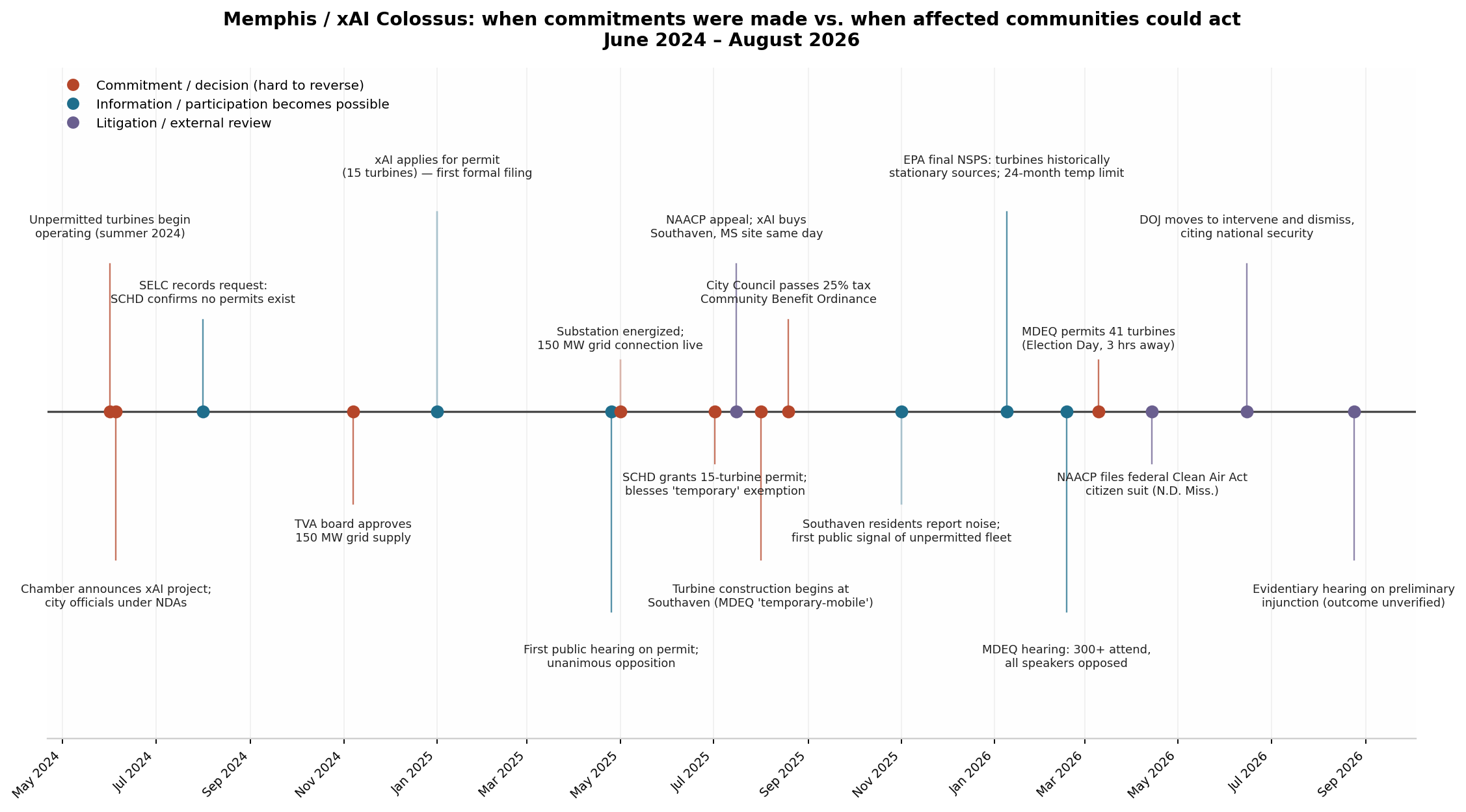
Major commitments accumulated before affected communities gained meaningful opportunities to participate or challenge them.
Two Kinds of Too Late
There are two gaps here, and they are worth keeping separate, because they fail differently and fix differently.
The first is the information gap: how much had become hard to reverse before affected people had reliable, verifiable information about what was happening. In Memphis, officials signed non-disclosure agreements before the announcement. In Hermantown, Minnesota, city leaders discussed a project privately for a year — changing land-use plans, doing preliminary environmental review — while refusing to tell residents what was being proposed. A community cannot act on information it does not have.
The second is the standing gap: how much had become hard to reverse before affected people had a meaningful way to influence the decision, even once they knew. This is the difference between knowing and being able to do something with the knowledge. A hearing everyone attends and no one can change is information without power.
The two gaps are connected but not the same. A community can be informed early and still powerless, or powerful on paper and kept ignorant until the moment is gone.
The Memphis record shows both — and something else. Some of the clearest facts about what was happening — how many turbines were actually running, when the permits were actually filed — did not come from the agencies that were supposed to disclose them. They came from records requests, aerial photography, satellite analysis, and litigation. When the most reliable public information system in a deployment is the lawsuit docket, the information problem is not a side effect. It is part of the governance failure.
Some consequential facts remain unresolved — the outcome of the federal litigation, the full health effect of the turbine emissions, and parts of the tax and employment picture. Those uncertainties do not change the sequence documented here. The order of events is the one part of this the record makes hard to dispute.
Minnesota Is Not the Clean Contrast
It would be tidy to say Minnesota did it right and Memphis did it wrong. The record will not cooperate.
Minnesota genuinely legislated first. In May, its public utilities commission approved a large-load tariff — a separate customer class for the biggest loads, fifteen-year terms, minimum payments, exit fees. The cost question is no longer just a statute. It has entered implementation.
But the local record shows the limits of good upstream design. One city’s environmental review was voided by a court after the final draft cut its estimate of a project’s greenhouse-gas emissions by 98 percent without explanation. Another project had construction paused. The same secrecy pattern that defined Memphis showed up in Hermantown.
So Minnesota demonstrates two things at once. Designing the rules before the wave arrives is real and necessary. And it is not sufficient — because those rules still have to be run by small local governments sitting across the table from billion-dollar companies, and some of them failed badly enough that courts had to step in.
Even the Good Parts Arrived Late
The sharpest detail in the record is not that Memphis dumped its costs on residents. It did not, at least not uniformly. The company funded most of its own substation. It accepted unusually strict terms that require it to cut demand during grid emergencies. Tax revenue is flowing to the surrounding neighborhoods. A water-recycling plant is being built — late and limited, but real.
Here is the thing. Those are all mechanisms that internalize cost and share benefit, and they were all adopted while deployment was already underway, after the siting decision was locked in behind closed doors. Even a company willing to pay its share could only negotiate the terms after the public’s chance to weigh in had passed.
That is what makes the sequence finding stronger than the cost finding. You can get the money right and still get the timing wrong.
Reorder, Don’t Just Slow Down
There is an obvious objection to all of this, and it deserves to be stated straight: if every jurisdiction insists on full disclosure and meaningful standing before anything is committed, the project simply goes somewhere faster. In this record, Mississippi competed on exactly that — speed, secrecy, and tax waivers it declined to quantify. A community that slows everything down does not get a better decision. It gets no project, and the pollution anyway, from a neighbor.
But that objection confuses two things. The failure was not speed. It was secrecy, and the placement of every public checkpoint after the point of no return. A jurisdiction can move fast and still sequence correctly: disclose early, put the standing where the decision is still reversible, and then build quickly. The fix is not endless process. It is reordering the process so the questions get asked while they can still change the answer.
The Question to Carry Forward
None of this settles whether any particular data center should be built. A fair process can conclude build, modify, relocate, delay, or reject. The point is narrower, and it travels — to energy projects, hospitals, transmission lines, factories, water systems, almost anything where a community lives with the consequences.
The question is not whether people had a say. It is whether they had it in time.
Participation after commitment is not the same as participation before it. By the time a community can reliably see what is happening and do something about it, how much of the decision has already become difficult to reverse? If the answer is “most of it,” then the system was never really asking for their consent — only their permission to proceed.
Dale Joseph is the author of Thought Partners: Preserving Cognitive Sovereignty in the Age of AI and founder of the Emergence Institute. He worked for years as a consultant helping install hospital networks before turning to writing and systems thinking. He lives in Boynton Beach, Florida.
Get the next essay
New essays on AI partnership and cognitive sovereignty, delivered to your inbox.